
This page provides tall desk height data 2026 for professionals between 6’2” and 6’8”. Most standard office desk recommendations are based on users between 5’7” and 5’11”. Professionals 6’2” and taller are often forced to compromise elbow alignment, monitor height, and shoulder positioning due to limited desk extension ranges.
This page compiles updated 2026 ergonomic desk and monitor height measurements specifically for tall professionals (6’2”–6’8”) using neutral posture alignment principles.
This data is intended for:
- Remote workers
- Office employees
- Workspace designers
- HR departments evaluating desk compatibility
Measurement Methodology
Desk height recommendations are based on:
- Neutral elbow angle (90–100 degrees)
- Forearms parallel to floor
- Shoulders relaxed (not elevated)
- Monitor top aligned at or slightly below eye level
Guidance references posture frameworks from:
- Occupational Safety and Health Administration
- Mayo Clinic
All measurements assume:
Standard seated posture with feet flat and neutral spine alignment.
For a complete breakdown of measurement logic and posture alignment, read our full guide on best desk height for tall people.
Seated Desk Height Data (6’2”–6’8”)
| Height | Recommended Desk Height (Seated) |
|---|---|
| 6’2” | 29.5–30.5 inches |
| 6’3” | 30–31 inches |
| 6’4” | 30.5–31.5 inches |
| 6’5” | 31–32 inches |
| 6’6” | 31.5–32.5 inches |
| 6’7” | 32–33 inches |
| 6’8” | 32.5–33.5 inches |
Note:
Fixed desks under 30” may cause shoulder elevation for users above 6’3”.
The following tall desk height data 2026 chart summarizes seated and standing measurements for professionals 6’2”–6’8”.
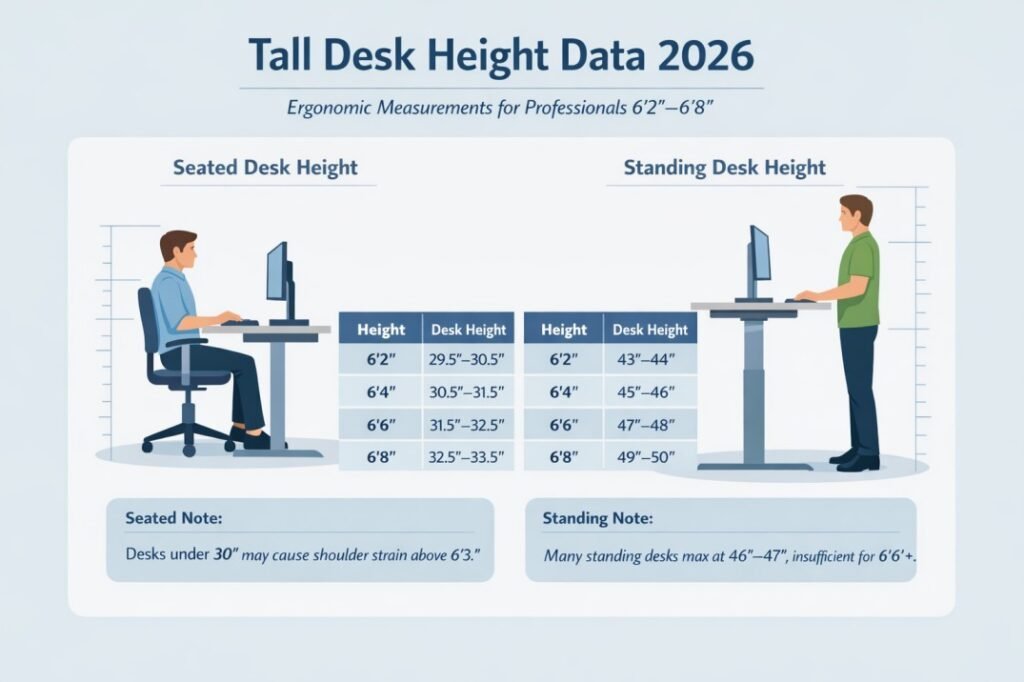
These ranges reflect neutral elbow positioning and proper monitor alignment for taller users.
Standing Desk Height Data (6’2”–6’8”)
| Height | Recommended Standing Desk Height |
|---|---|
| 6’2” | 43–44 inches |
| 6’3” | 44–45 inches |
| 6’4” | 45–46 inches |
| 6’5” | 46–47 inches |
| 6’6” | 47–48 inches |
| 6’7” | 48–49 inches |
| 6’8” | 49–50 inches |
Critical Note:
Many budget standing desks max out at 46–47 inches, which may not properly support users above 6’6”.
Why Standard Desk Recommendations Fail Tall Users
Most commercially available desks are manufactured within a 28–30 inch seated height range because they are designed around average population height data (approximately 5’7”–5’11”). This creates an ergonomic mismatch for professionals above 6’2”.
When a desk surface is too low for a taller user, the following issues commonly occur:
- Shoulder elevation to compensate for low elbow angle
- Wrist extension due to improper forearm alignment
- Upper trapezius strain from sustained elevation
- Forward head posture caused by low monitor positioning
This is why tall desk height data 2026 recommendations differ from generic ergonomic advice. Height-specific measurement is not optional for professionals above 6’3” — it is necessary to maintain neutral joint alignment.
For detailed seated alignment principles, refer to guidance from the Occupational Safety and Health Administration on workstation positioning standards.
Monitor Height Alignment for Tall Users
For users 6’2”–6’8”:
- Top of monitor should align at or slightly below eye level.
- Viewing distance: 20–30 inches.
- Taller users often require monitor arms with extended vertical travel.
Standard monitor stands are frequently too short for users 6’5” and above.
Desk Compatibility Checklist for Offices and Remote Workers
Before purchasing or approving office furniture for taller professionals, use the following compatibility checklist based on tall desk height data 2026 benchmarks:
Minimum Seated Desk Height:
Must extend to at least 31–33 inches for users above 6’4”.
Minimum Standing Desk Height:
Should reach 48–50 inches for users 6’7”–6’8”.
Monitor Arm Vertical Travel:
Must allow sufficient upward adjustment to position the top of screen at or slightly below eye level.
Chair Cylinder Extension:
Tall users often require extended-height gas cylinders to maintain proper knee angle.
For medical posture considerations and neck alignment guidance, see ergonomic posture recommendations published by the Mayo Clinic.
This checklist is especially relevant for HR teams managing distributed or hybrid workforces.
Common Compatibility Issues for Tall Professionals
- Desk max height limitations
- Chair cylinder height limits
- Monitor arm vertical travel constraints
- Keyboard tray clearance issues
These constraints are often overlooked in general ergonomic advice.
Procurement Considerations for HR and Workspace Designers
Organizations that standardize desk procurement without accounting for taller employees often create long-term ergonomic limitations.
When evaluating desk systems, confirm:
- Maximum seated adjustment range
- Maximum standing extension range
- Stability at full height extension
- Compatibility with tall-user monitor arm systems
For organizations employing professionals 6’5” and above, it is recommended to evaluate workstation flexibility beyond standard catalog specifications.
For a complete breakdown of seated measurements and height calculations, review our detailed guide on correct desk height for tall professionals.
Additionally, standing configurations are explained in our companion resource covering standing desk height recommendations for tall users.
Download Height Chart (PDF)
How This Data Is Used
This data may be referenced in:
- Workspace planning
- Office furniture procurement
- Remote employee setup guides
- Standing desk compatibility research
For citations or collaboration inquiries:
research@tallerogdesk.com