7 Best Office Chairs for Tall People (2026 Buyer’s Guide)
Introduction
The best office chairs for tall people are a critical component of an ergonomic workspace, not just an accessory to desk height. While choosing the correct desk height matters, tall users rely heavily on proper seating and leg support to prevent back pain, hip discomfort, and circulation issues during long workdays.
Many standard office chairs and footrests are designed for average-height users, leaving taller individuals with inadequate seat depth, poor thigh support, or improper leg positioning. This guide explains how to choose the best office chairs for tall people, how footrests support taller leg proportions, which ergonomic features matter most, and how seating ergonomics work together with proper desk height to support comfort and posture during long work hours.
Quick Recommendations
Best Overall: Steelcase Leap Plus
Best Premium Chair: Herman Miller Aeron Size C
Best for Big & Tall Users: Secretlab Titan Evo XL
Best Value: HON Wave Big and Tall
Best for Very Tall Users (6’5″+): Secretlab Titan Evo XL
Best Budget Choice: SIHOO Doro C300
The best office chairs for tall people provide sufficient seat depth, adjustable lumbar support, higher seat height ranges, and strong back support for long workdays. The chairs below offer the best balance of ergonomics, comfort, and adjustability for taller professionals.
Key Features of the Best Office Chairs for Tall People
The best office chairs for tall people are designed to support larger body proportions, longer legs, and higher seated eye levels without forcing poor posture. Unlike standard office chairs, which often prioritize compact sizing, chairs built for tall users focus on adjustability, depth, and vertical support.
When evaluating the best office chairs for tall people, prioritize the following features:
Extended seat depth
Tall users require deeper seats to support the full length of the thighs without pressure behind the knees. A proper seat depth allows the user to sit fully back against the backrest while maintaining circulation.
Higher seat height range
Many chairs top out too low for tall users. The best office chairs for tall people offer a higher maximum seat height to align thighs parallel to the floor while keeping feet supported.
Full-height backrest and head support
A taller backrest ensures proper lumbar, mid-back, and shoulder support. For users over 6’0”, headrests should adjust both vertically and horizontally to prevent neck strain.
Adjustable lumbar support
Lumbar support should move vertically to match longer torsos. Fixed lumbar supports often sit too low and fail to support tall users correctly.
Sturdy frame and weight capacity
Chairs designed for tall people typically use reinforced frames and wider bases to maintain stability at higher seat heights.
Without these features, even premium chairs can cause discomfort when used for long hours. Selecting a chair that accommodates tall proportions is essential for maintaining proper posture and long-term comfort.
Comparison Table — Best Office Chairs for Tall People
| Chair | Recommended Height | Seat Depth | Best For |
|---|---|---|---|
| Steelcase Leap Plus | Up to 6’8″ | Adjustable | Best Overall |
| Herman Miller Aeron Size C | Up to 6’7″ | Deep Seat | Premium Comfort |
| Secretlab Titan Evo XL | Up to 6’9″ | Wide Seat | Big & Tall Users |
| HON Wave Big & Tall | Up to 6’6″ | Extra Deep | Value Option |
| SIHOO Doro C300 | Up to 6’4″ | Adjustable | Budget Choice |
Why Chairs and Footrests Matter for Tall People
Tall users place different demands on seating equipment due to longer legs, higher knee position, and greater seat-depth requirements. When a chair or footrest does not accommodate these proportions, posture problems quickly develop.
Common issues include:
- Pressure behind the knees from shallow seats
- Unsupported thighs causing hip fatigue
- Feet dangling when chair height is raised
- Lower back strain from inadequate lumbar positioning
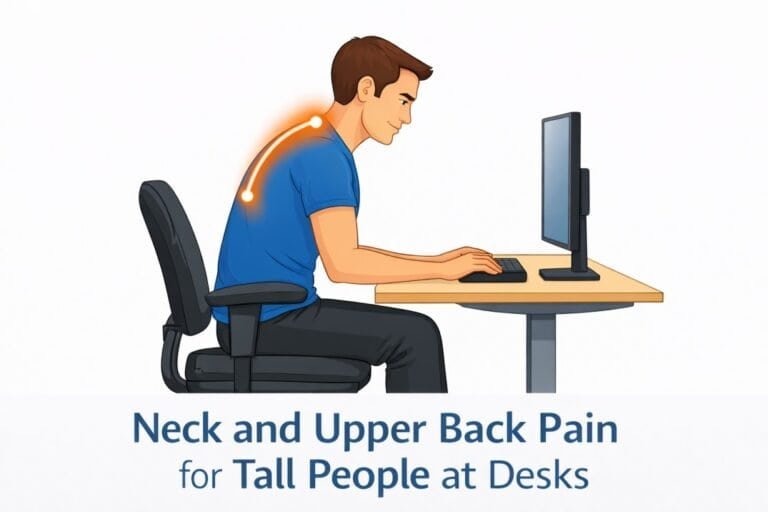
A proper seating setup should always complement correct desk height. Many of these issues originate from incorrect desk height foundations for tall people, which should be addressed first before fine-tuning seating adjustments. In our guide Neck and upper back pain for tall people at desks, we break down the real causes of neck and upper back pain for tall desk workers and show you practical, ergonomic fixes that actually work.
Also proper desk height must align with seated elbow angle. Our tall desk height data study explains the numerical ranges in detail.
Best Office Chair Features for Tall People
Not all “ergonomic” chairs are suitable for taller users. The following features are critical when selecting the best office chairs for tall people.
Seat Height and Depth
Tall users need:
- Higher maximum seat height
- Deep seat pan (18–20 inches or more)
- Adjustable seat depth to prevent knee pressure
A seat that is too shallow forces tall users to perch forward, reducing back support and increasing fatigue.
What Seat Depth and Height Range Should Tall Users Look For?
For tall users, seat depth and seat height are two of the most important chair measurements to check before buying. A chair can have excellent lumbar support and still feel uncomfortable if the seat is too short or the seat height does not allow your legs to sit naturally.
Seat depth: Look for a seat pan that provides enough support for most of your thighs without pressing into the back of your knees. As a general starting point, many taller users should look for approximately 18–20 inches of usable seat depth, preferably with adjustable seat depth. The right depth allows you to sit fully back against the backrest while leaving a small gap between the front edge of the seat and the back of your knees.
Seat height: Tall users generally benefit from a chair with a higher maximum seat height than standard office chairs. When seated, your feet should remain supported, your knees should be approximately level with or slightly below your hips, and your thighs should be supported without excessive pressure behind the knees.
Adjustability matters more than a single measurement. There is no universal seat height or depth that works for every tall person because leg length, torso length, footwear, and desk height all vary. A chair with adjustable seat depth and a sufficiently high seat-height range gives you more flexibility to establish a comfortable position.
Before choosing an office chair for tall users, check the manufacturer’s actual seat-depth and seat-height specifications rather than relying only on labels such as “ergonomic,” “big and tall,” or “executive.” If possible, compare the chair’s adjustment range with your existing desk height and sitting position.
A useful rule is simple: your chair should allow you to sit fully back with your thighs supported while keeping your feet properly supported and your shoulders relaxed. If achieving one of these positions forces you to compromise another, the chair may not have enough adjustment range for your body proportions.
This is particularly important for tall professionals who alternate between sitting and standing. Your seated setup should work together with your desk height, monitor position, keyboard placement, and armrest height rather than being adjusted independently.
Backrest and Lumbar Support
Proper lumbar support should align with the natural curve of the lower spine. For tall users:
- Adjustable lumbar height is essential
- High backrests or headrests are preferred
- Recline tension should support larger frames
Without correct lumbar alignment, even the best desk setup can cause long-term discomfort.
Armrest Adjustability
Armrests must:
- Adjust high enough for tall users
- Allow elbows to rest naturally at desk height
- Avoid forcing shoulders upward
Armrest height should work with your desk height to keep the elbows in a comfortable position and the shoulders relaxed. If you alternate between sitting and standing, see our Best Standing Desk Height for Tall People guide for the principles behind proper standing desk positioning.
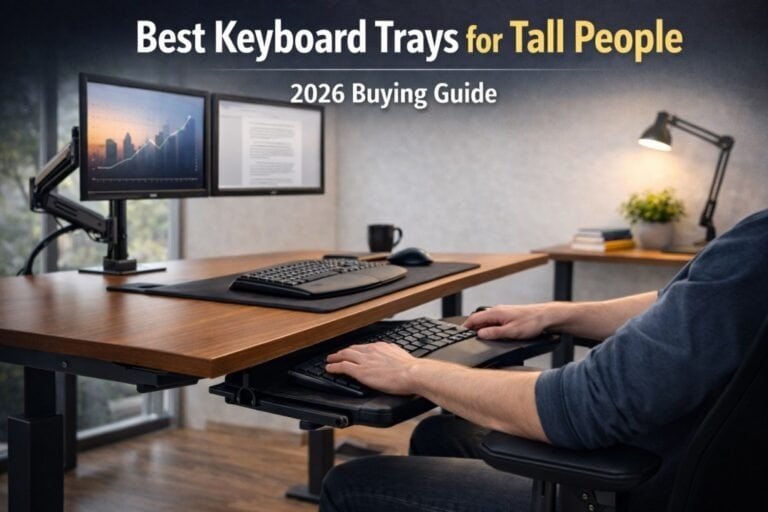
Even the most adjustable chair cannot compensate for a desk that is too high, which is why some tall users pair proper seating with an adjustable keyboard tray for tall people to improve elbow and wrist positioning.
Recommended Office Chairs for Tall People
Steelcase Leap Plus
The Steelcase Leap Plus is widely considered one of the best office chairs for tall people due to its exceptional adjustability, deep seat design, and strong lumbar support. The chair accommodates larger body frames while maintaining excellent ergonomic positioning.
Pros
- Adjustable seat depth
- Excellent lumbar support
- High weight capacity
- Built for long workdays
Cons
- Premium price
Herman Miller Aeron Size C
The Aeron Size C is designed specifically for larger and taller users. Its breathable mesh design and ergonomic support system make it a popular choice for professionals who spend long hours at a desk.
Pros
- Outstanding build quality
- Breathable mesh
- Excellent back support
Cons
- Expensive
- Limited seat padding
Secretlab Titan Evo XL
Although originally marketed toward gamers, the Titan Evo XL has become a popular option for tall professionals because of its wide seat, tall backrest, and adjustable lumbar support.
Pros
- Excellent for users over 6’4″
- Wide seating area
- Strong headrest support
Cons
- Firm seat cushion
HON Wave Big & Tall
The HON Wave offers strong ergonomic performance at a more affordable price point. It provides additional seat depth and weight capacity compared with standard office chairs.
Pros
- Good value
- Deep seat
- Suitable for taller users
Cons
- Fewer adjustment options
SIHOO Doro C300
The SIHOO Doro C300 provides many ergonomic features typically found in higher-priced chairs while maintaining a budget-friendly price.
Pros
- Affordable
- Adjustable lumbar support
- Modern ergonomic design
Cons
- Less suitable for extremely tall users
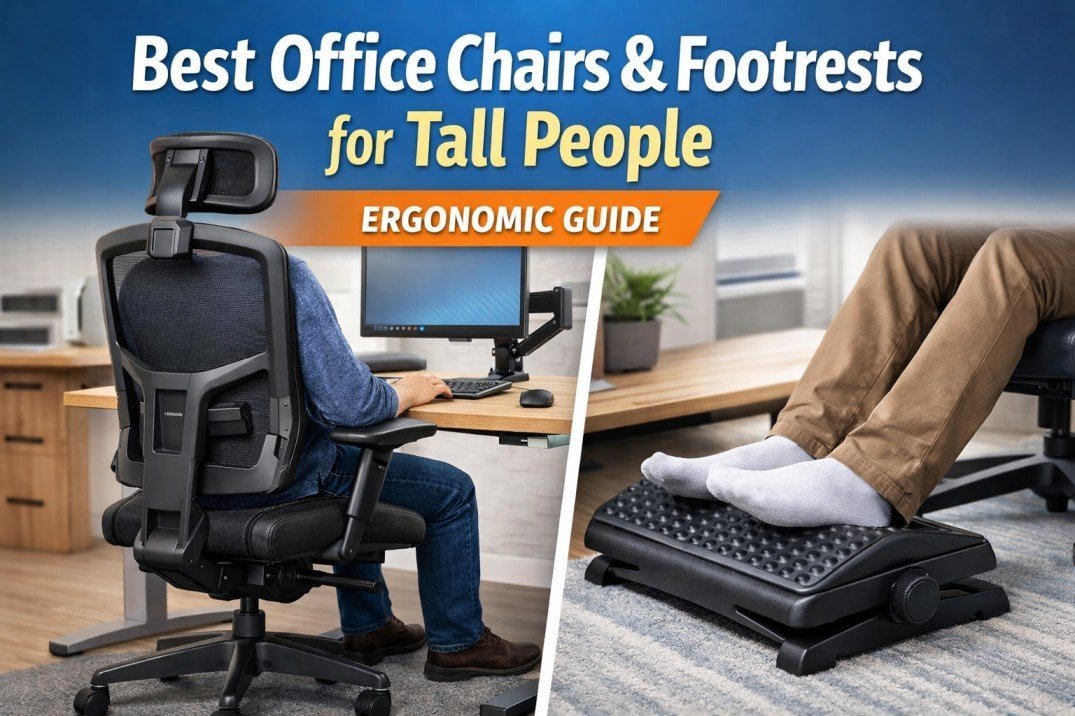
Best Footrest Options for Tall Users
Footrests are often overlooked, but they are critical when chair height is raised to match a tall desk setup.
When Tall People Need a Footrest
You likely need a footrest if:
- Your feet do not rest flat after raising your chair
- Pressure builds behind the thighs
- You feel lower-back strain despite proper chair height
A footrest restores proper leg support without lowering the chair and compromising desk alignment.
What to Look for in a Footrest
The best footrests for tall people should offer:
- Adjustable height and angle
- Wide platform for larger feet
- Non-slip surface
- Firm support (not overly cushioned)
Footrests should support circulation and reduce static posture during long seated sessions.
Chair Height, Footrests, and Desk Height: How They Work Together
Ergonomics is a system, not individual components. Chair height, footrests, and desk height must be adjusted together to achieve a neutral posture.
A correct setup follows this order:
- Set desk height based on elbow alignment
- Adjust chair height to match desk height
- Add a footrest if feet do not rest flat
- Fine-tune lumbar and armrest positioning
This approach aligns with the same posture and positioning principles used in our Best Ergonomic Desk Setup for Tall People guide, where we explain how desk height, seating, monitor position, and accessories should work together.
This approach also aligns with research-backed ergonomic seating guidelines.
According to Cornell University’s Ergonomics Program, chair height should be adjusted so the thighs remain approximately parallel to the floor while maintaining proper workstation alignment.
Common Seating Mistakes Tall People Should Avoid
Even with quality equipment, tall users often make avoidable mistakes.
Avoid:
- Choosing chairs labeled “ergonomic” without checking dimensions
- Ignoring seat depth measurements
- Raising chair height without adding a footrest
- Using fixed armrests that limit shoulder relaxation
Many of these issues overlap with common standing desk mistakes tall people should avoid, especially when switching between seated and standing work without readjusting seating components.
Frequently Asked Questions
What is the best office chair for tall people?
The Steelcase Leap Plus is one of the best office chairs for tall people due to its exceptional adjustability, deep seat design, and ergonomic support.
Do tall people need a footrest?
Some do. If raising the chair to match desk height causes the feet to lose contact with the floor, a footrest helps restore proper leg support.
What seat depth should tall users look for?
Most tall users benefit from seat depths between 18 and 21 inches, preferably with seat depth adjustment.
Are gaming chairs good for tall people?
Some are. Models such as the Secretlab Titan Evo XL provide sufficient height and seat dimensions for taller users.
Final Thoughts: Completing an Ergonomic Setup for Tall People
The best office chairs and footrests for tall people provide the foundation for a comfortable, sustainable workspace. Without proper seating support, even the most advanced standing desk cannot prevent strain or fatigue.
By choosing adjustable chairs, using footrests when needed, and aligning seating with correct desk height, tall professionals who work remotely can build workstations that support posture, productivity, and long-term health. To learn more, see our guide about best desk setup for tall remote workers.
For a broader overview of seating principles, chair selection, and ergonomic considerations, see our complete chairs for tall people guide.
At TallErgoDesk, we focus on helping tall users design complete ergonomic systems—not just desks—so every component works together effectively.